Powell Homeowner's Equity Guide | Value & Downsizing
Powell, Ohio · Homeowner Equity & Local Market Intelligence · October 2026

Your Powell home may be more than the place where you raised a family, welcomed friends, or built your life. For many longtime homeowners, it is also one of their most significant financial assets. Understanding that equity can make the difference between wondering about your next chapter and planning it with confidence.
Quick answer: What is home equity, and why does it matter in Powell? Home equity is the estimated current market value of your home minus mortgage and other property-secured loan balances. It can influence your decisions to stay, renovate, downsize, relocate, or purchase another home. But equity is not the same as the cash you would receive after selling; transaction costs, payoffs, and possible taxes also matter.
I work with homeowners throughout Powell, Dublin, Lewis Center, and southern Delaware County who have lived in their homes for ten, fifteen, or twenty years. Often, the question is not simply, “Can we sell?” It is, “What choices would selling create—and would those choices improve our lives?”
This guide explains how to think about equity, what current Powell MLS research actually says, and how to evaluate your options without feeling pressured to make a move.
1. Home value, home equity, and net proceeds are three different numbers
These terms are frequently used interchangeably, but they answer three different questions. Market value is what a qualified buyer might reasonably pay for your property under current conditions. Gross equity is that estimated value minus mortgage balances, HELOC balances, and other liens secured by the property. Estimated net proceeds are what may remain after a completed sale, payoff amounts, commissions and other transaction expenses, concessions, and any applicable obligations.
For example, suppose an established Powell home could sell for $1,000,000 and the owner has a $175,000 mortgage balance. The simple equity calculation is:
$1,000,000 estimated market value − $175,000 mortgage balance = $825,000 estimated gross equity.
That $825,000 is not a promise of cash at closing. To estimate spendable proceeds, the owner still needs a selling-cost estimate and accurate payoff figures.
A homeowner with no mortgage may have gross equity close to the full market value, but even a mortgage-free seller incurs transaction expenses. Conversely, someone with a low-rate existing mortgage may find that keeping the current home has real financial advantages. The right answer depends on both the numbers and the lifestyle goal.
2. What does Powell's 2026 housing market say about your equity?
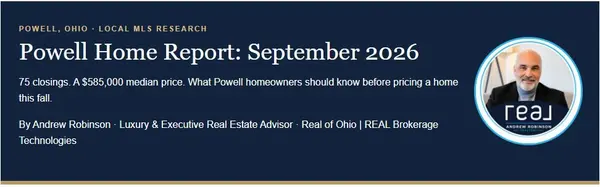
Broad market headlines offer context, not a personalized valuation. My September 2026 Powell Home Report, based on 75 closed MLS transactions with Powell mailing addresses, recorded a median sold price of $585,000, an average of $620,892, and six sales at $1 million or higher. Average valid market time was approximately 37 days, versus a 17-day median.
Source: Andrew Robinson's September 2026 analysis of a Columbus-area MLS export, Powell mailing addresses, all included property types. Results are not a valuation of any individual home or a municipal-boundary-only study.
Where September's closed sales occurred by price range
75 September closings. Bars are scaled to the largest category of 32 sales. Price tier is based on final sold price.
Why does this matter if you own a $900,000 or $1.4 million home? The median of all sales is not your comparable market. A custom home on acreage, a property in Wedgewood or Woodland Glen, and a patio home in a low-maintenance community can attract very different buyers. In the luxury segment, a handful of closings can substantially move an average.
My broader 2025–2026 Powell resale analysis examined 1,753 MLS listing records. For comparable January 1–October 19 reporting periods, 2026 closed sales were approximately 4.8% lower and average market time about 30.5% higher. On October 19, 65 of 108 active resale listings—60.2%—were advertised below their original asking prices. Those are signals to assess current competition carefully, not proof that each individual home has lost value.
3. Five factors that can change the value of your particular home
Neighborhood and school-district boundaries
A Powell mailing address does not describe one uniform market. Buyers may weigh Olentangy or Dublin school assignments, commute routes, lot characteristics, privacy, golf access, and proximity to downtown Powell differently. Confirm the school assignment for a particular parcel rather than assuming it from its mailing city.
Condition and the cost of modernization
Updated kitchens, refreshed bathrooms, mechanical systems, and well-maintained exteriors may help a home compete. Yet renovations do not automatically return their full cost. In higher-end properties, buyers often budget for substantial changes to dated finishes. Before investing in a major remodel, compare the likely resale impact with the cost, timetable, and disruption.
Floor plan and lifestyle fit
A first-floor owner's suite, manageable stairs, functional workspaces, ample storage, and usable outdoor living can matter more to some buyers than an extra formal room. A home that served a growing family beautifully may appeal to a different group of buyers today. Positioning should highlight the features those buyers are seeking.
Current competing listings
Closed sales tell us what buyers recently paid. Active homes tell us what a buyer can choose right now. Pending listings add context about where demand appears to be meeting supply. A useful valuation weighs all three rather than simply applying an appreciation percentage to what you paid years ago.
Price range and buyer depth
High-end demand can be remarkably selective. In my separate study of Powell-area $900,000–$1.1 million resale homes, 20 of 33 completed 2026 sales recorded seven days on market or fewer. Yet the eight active listings in that band as of October 19 had a median reported market time of 43.5 days. Fast completed sales and slower unsold inventory coexist. That distinction should shape both price expectations and moving timelines.
4. Calculate a realistic range of possible sale proceeds
For planning purposes, I recommend a range rather than a single precise prediction. Begin with a conservative, likely, and stronger-outcome sale-price scenario. Then use an actual mortgage payoff quote and an itemized estimate of closing expenses. Include any known repair allowance or buyer concession you are willing to consider.
| Illustrative scenario | Conservative | Middle | Stronger |
|---|---|---|---|
| Sale price | $950,000 | $1,000,000 | $1,050,000 |
| Mortgage payoff | −$175,000 | −$175,000 | −$175,000 |
| Illustrative combined transaction expenses and concessions | −$55,000 | −$55,000 | −$55,000 |
| Illustrative proceeds before other obligations and any taxes | $720,000 | $770,000 | $820,000 |
Hypothetical arithmetic only, not a valuation or estimate of customary commissions. The $55,000 expense line is an assumed combined amount for this example, not a market rate or quote. Broker compensation is negotiable; actual payoff, expenses, repairs, concessions, prorations, moving costs, and potential taxes depend on the transaction.
In this example, a $100,000 spread between possible sale prices changes estimated proceeds by $100,000 when all other assumptions are held constant. That is why a neighborhood-specific pricing review is more useful than an isolated online number. It is also why some sellers choose modest preparations before listing, while others prioritize timing and simplicity.
5. Four ways to use the choices your equity may create
Option A: Stay and adapt your current home
Not every equity conversation needs to end with a sale. If you love your neighbors, location, and outdoor space, modifications may better support your next decade. Think about creating a first-floor bedroom, improving accessibility, reducing exterior maintenance, or converting underused rooms into more functional space.
Price those changes realistically and consider whether they solve the problem that prompted you to explore moving. Borrowing against equity through a HELOC or home equity loan adds repayment obligations and puts the home at risk if you cannot repay. The Consumer Financial Protection Bureau recommends careful review of payment terms, variable-rate exposure, and risks.
Option B: Downsize without giving up the lifestyle you enjoy
Many Powell homeowners want less maintenance, fewer rooms, and more flexibility—not necessarily a less comfortable home. A high-quality patio home or first-floor-living design may cost more per square foot than the older family home it replaces. The comparison should be based on total ownership costs, amenities, design, and lifestyle rather than square footage alone.
Consider homeowners association fees, taxes, insurance, landscaping responsibilities, future assessments, proximity to family, and the availability of suitable inventory. My Powell Downsizing Guide explores those tradeoffs in greater depth.
Option C: Relocate or pursue a different community
For some households, equity supports a move closer to grandchildren, warmer weather, a smaller lot, or a preferred golf or lake setting. When comparing locations, establish the anticipated net proceeds from Powell and the full cost of the next property. Taxes, insurance, association dues, and travel expenses may materially change the economics.
Keep a reserve for moving, repairs, and the unexpected. A lower purchase price does not necessarily mean a lower monthly cost, and a mortgage-free next home is not always the most flexible choice for every household.
Option D: Buy the next home before selling
One of the most stressful parts of downsizing is the timing: you do not want to sell your current property and then feel forced into the wrong next home. Depending on finances and lender qualification, potential strategies include a home-sale contingency, temporary financing, a HELOC arranged before moving, or negotiated possession after closing.
Each has costs and risks. Temporary financing can increase carrying expenses, and contingent offers may compete differently against noncontingent offers. Coordinate with a trusted lender before making commitments. A real estate plan should outline what happens if the current house sells faster—or slower—than anticipated.
6. Do not confuse taxable gain with equity
This distinction deserves special attention for homeowners who purchased many years ago. Equity is generally the home's market value minus secured debt. Capital gain for tax purposes is calculated under separate rules involving the selling price, adjusted tax basis, certain selling expenses, and other adjustments. Paying off a mortgage does not determine your taxable gain.
Under the IRS rules for selling a main home, an eligible taxpayer may be able to exclude up to $250,000 of gain, or up to $500,000 for many qualifying married couples filing jointly. In general, the ownership and use tests look for at least two years of ownership and two years of use as a principal residence during the five years before sale. Other rules and exceptions can apply, including prior exclusions, rental use, and depreciation.
For owners of homes that have appreciated considerably, this is an important conversation to have with a tax professional before listing. Preserve records of qualifying capital improvements and ask how they affect adjusted basis. Do not assume that all proceeds are taxable—or that all gains are exempt. The IRS Publication 523 explains the calculation and eligibility tests in detail.
7. Why an automated home estimate is only a starting point
Automated valuation tools can be helpful for quick orientation. They typically use available property records, algorithms, and sale data. But they may miss interior renovations, deferred maintenance, a premium wooded setting, an unusual floor plan, or the realities of a small luxury buyer pool.
A comparative market analysis examines relevant comparable sales and adjusts for meaningful differences. It should also identify current competitors, likely buyer objections, and realistic selling windows. A formal appraisal has a different purpose and scope. None of the three should be treated as an absolute guarantee of the eventual sale price.
In Powell, even two houses of similar size can command different responses because one offers updated finishes and easy first-floor living while the other requires an extensive renovation. For luxury properties, the strongest analysis explains the why behind the proposed range, not merely the final number.
8. A practical 90-day equity-planning checklist
- Clarify your goal. Is it lower maintenance, more travel, proximity to family, better accessibility, or improved liquidity?
- Gather the numbers. Request current mortgage and HELOC payoff information; make a list of known repairs and major improvements.
- Get a local market review. Ask for a defensible value range, not only an automated estimate, including recent sold, active, and pending comparables.
- Estimate net proceeds. Consider transaction expenses, concessions, taxes, and realistic sale-price scenarios.
- Research the next home. Compare suitable patio homes, ranch layouts, or communities with your current total ownership cost.
- Build two timelines. Map a fast sale and a slower sale so your next purchase does not depend on one perfect outcome.
- Consult your advisers. Your lender, financial planner, tax professional, and real estate advisor can help evaluate issues that fall outside a listing analysis.
If a move is still six to twelve months away, this work is not premature. It may help you prioritize repairs, avoid unnecessary spending, and act with confidence when the right next home appears.
Frequently asked questions about Powell home equity
How much equity do I have in my Powell home?
Start with a realistic current market-value estimate and subtract the balances of mortgages, HELOCs, and other property-secured liens. That gives an approximate gross equity figure; it does not deduct selling expenses or taxes.
Does a $1 million home mean I have $1 million to spend?
No. Any secured debts, closing expenses, concessions, and other obligations reduce the amount available from a sale. Tax treatment depends on your circumstances, too. A written net-proceeds worksheet is the better planning tool.
Should I renovate before selling an older luxury home?
Not automatically. Compare renovation cost and time with the price difference supported by direct comparables. Selective painting, repairs, cleaning, and presentation improvements may offer a better tradeoff than a large remodel. The answer changes by neighborhood and target buyer.
Is now a good time to downsize in Powell?
That depends on your home's likely sale price, what you want to purchase, and whether the overall move improves your lifestyle and finances. Powell's 2026 market has buyers for well-positioned homes, but selectivity is higher in some price ranges. Plan both sides of the transaction before making a decision.
Can I access equity without selling?
Potentially, through products such as home equity loans or lines of credit, subject to lender approval. These create debts and repayment risks; they are not the same as releasing equity through a sale. Ask a qualified lender to explain all terms and alternatives.
What could your Powell home make possible?
If you are beginning to think about a move in the next 3–12 months, I can help you understand your home's likely market range, the competition it would face, and the practical options that equity may open up. There is no obligation to list your home.
Request My Powell Home Value AnalysisOr call Andrew Robinson at 614-323-1249. You can also explore Powell homes and neighborhoods.
For more local research, see the September Powell Home Report, my analysis of million-dollar sale timing, and other relevant articles at FindHomesInOhio.com/blog.
Research notes: Powell MLS statistics are from Andrew Robinson's published local research using supplied Columbus-area MLS exports. September 2026 figures cover 75 closed properties with Powell mailing addresses. The October 19, 2026 comparison covers existing detached resale listings in a separate 1,753-record 2025–2026 sample; the two groups should not be combined as though they use identical property filters. Market conditions and property-specific values can change. Educational information only; not an appraisal, tax, legal, investment, or lending opinion. Consult appropriately licensed professionals for those matters. Information deemed reliable, not guaranteed. Equal Housing Opportunity.
Categories
Recent Posts