Is Powell, Ohio Still a Seller’s Market in the Summer of 2026? 10 Questions Buyers and Sellers Are Asking
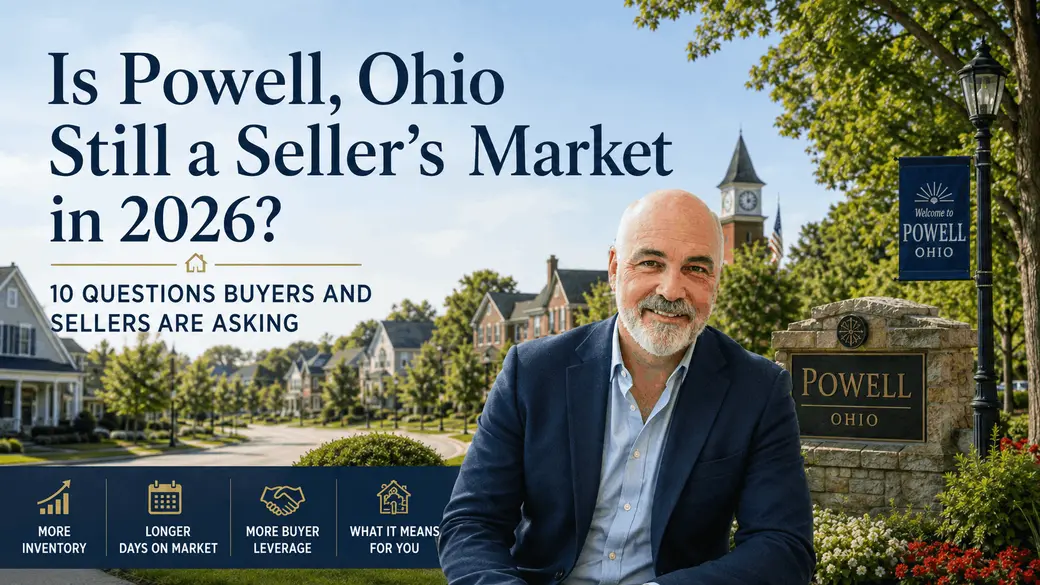

The Powell, Ohio housing market has changed meaningfully from summer 2025 to summer 2026.
Inventory is higher, homes are taking longer to sell, and buyers have more choices. Powell is still broadly a seller-favored market, but today's buyers are considerably more selective—and that makes pricing, condition and marketing increasingly important.
If you have been thinking about buying or selling a home in Powell, you may be wondering whether the real estate market has finally shifted.
The short answer is yes—but probably not in the dramatic way some national housing headlines might suggest.
Powell has not suddenly become a buyer's market, nor have buyers disappeared. Instead, we are moving from the extremely inventory-constrained conditions of recent years toward a more normalized and selective housing market.
For homeowners, this means the strategy that worked in 2024 or 2025 may not produce the same result in 2026. For buyers, it means there may finally be more opportunity to compare homes, negotiate terms and make a thoughtful decision rather than feeling pressured to immediately compete for every desirable property.
Powell Real Estate Market at a Glance
| Powell Market Metric | 2025 | 2026 | Change |
|---|---|---|---|
| June inventory | 28 homes | 38 homes | +35.7% |
| Months of supply | 1.7 | 2.4 | +41% |
| Avg. DOM – first half | 20 days | 39 days | +95% |
| Q2 Avg. DOM | 19 days | 27 days | +42% |
1. Is Powell, Ohio Still a Seller's Market in 2026?
Yes—but it is a much more selective seller's market than it was a year ago.
One of the best ways to evaluate the balance between buyers and sellers is through months of housing supply, sometimes referred to as the absorption rate.
Powell's available housing supply has increased from approximately 1.7 months in summer 2025 to 2.4 months in summer 2026.
Historically, a market with approximately four to six months of inventory has often been considered relatively balanced. At 2.4 months, Powell remains below that benchmark.
A 41% increase in available supply gives buyers meaningfully more choice even though overall inventory remains relatively constrained.
2. Are There More Homes for Sale in Powell Than Last Year?
Yes. Increasing inventory is arguably the biggest Powell real estate story of 2026.
Powell-specific data showed June inventory increasing from approximately 28 homes in 2025 to 38 homes in 2026—an increase of nearly 36%.
A separate second-quarter market analysis showed inventory increasing approximately 25% year over year.
This trend is not limited to Powell. Across Central Ohio, July 2026 inventory reached approximately 6,193 homes compared with 5,638 in July 2025, representing the highest July inventory level in more than a decade.
More inventory does not necessarily mean there are too many homes for sale. It means buyers have more alternatives.
When buyers have choices, they begin comparing price, updates, floor plan, location, school district, lot, outdoor living, age of mechanical systems, taxes and overall value much more carefully.
3. How Long Does It Take to Sell a Home in Powell in 2026?
Homes are generally taking longer to sell than they did in 2025.
First-half Powell data indicate average days on market increased from approximately 20 days in 2025 to 39 days in 2026.
Looking specifically at the second quarter, average market time increased from approximately 19 days to 27 days—or about 42%.
That does not mean every Powell home will take a month or more to sell. In fact, one of the defining features of today's market is how segmented it has become.
A well-updated home with strong photography, a desirable setting, thoughtful preparation and compelling pricing can still attract buyers quickly.
Another property only a few streets away can sit for weeks or months if buyers believe it is overpriced relative to its condition or competing inventory.
4. Are Powell Home Prices Falling?
This question requires some context.
Certain market reports have shown Powell median prices lower on a year-over-year basis during portions of 2026, while other measurements of home values have remained relatively flat.
That does not mean the value of every Powell home has declined by the same percentage.
Median and average prices can change because the mix of properties selling changes. If more moderately priced homes sell during one period and fewer luxury homes close, the citywide median can decline even if comparable individual properties retain much of their value.
Powell also contains a remarkably broad range of housing—from established neighborhoods and patio homes to golf-course communities, acreage properties, newer construction and multi-million-dollar custom homes.
For that reason, a property-specific market analysis is generally much more useful than relying solely on a citywide average or an automated online home valuation.
Get a property-specific analysis based on today's competition—not simply an automated estimate.
Request a Selling Consultation →5. Why Are Some Powell Homes Selling Quickly While Others Sit?
This may be the most important question for homeowners in 2026.
Buyers are still purchasing homes. What has changed is buyer selectivity.
The properties receiving the strongest response generally offer the best combination of:
- Correct initial pricing relative to both recent sales and active competition.
- Move-in-ready condition or pricing that appropriately reflects needed improvements.
- Professional presentation through photography, video, floor plans, 3D tours and staging.
- A desirable location or setting, including quiet streets, views, yards and proximity to amenities.
- Functional floor plans with spaces today's buyers actually want.
The critical takeaway is that buyers are no longer simply buying the next available house.
They are comparing value.
6. Are Multiple Offers Gone in Powell?
No. Multiple offers can absolutely still occur, particularly when a desirable property enters the market at an attractive price.
What has changed is that multiple offers are less automatic.
During an extremely tight seller's market, a home might attract several offers simply because buyers had very few alternatives.
Today, multiple offers tend to concentrate around properties buyers perceive as offering exceptional value. That may mean beautiful renovations, a particularly desirable lot, a difficult-to-find floor plan or simply a price that creates immediate buyer interest.
7. What Does Powell's Absorption Rate Mean?
Think of months of supply as answering this hypothetical question:
If no additional homes came onto the market, how long would it take buyers to purchase the existing inventory at the current sales pace?
During summer 2025, Powell's inventory represented roughly seven weeks of supply.
By summer 2026, that figure increased to approximately 10½ weeks.
Both figures still represent relatively constrained inventory. But there is an important behavioral difference.
When inventory is exceptionally low, buyers worry that if they do not buy today's house they may not see another desirable option for months.
As inventory increases, buyers become more comfortable waiting.
And reduced urgency changes the negotiating dynamic.
8. What Does the 2026 Powell Market Mean for Sellers?
Price for the market you are entering—not the market you remember.
A sale from 2024 or early 2025 is useful information, but buyers are comparing your home with the properties they can purchase today.
The first few weeks matter.
A property's strongest exposure typically occurs when it first enters the market. A later price reduction can help, but you cannot completely recreate the excitement of being a new listing.
Condition and presentation matter more.
That does not necessarily mean undertaking a major renovation. Strategic paint, landscaping, lighting, cleaning, repairs, decluttering and staging may provide a much better return.
You can learn more about my real estate experience on my About Andrew Robinson page or read reviews from past Central Ohio buyers and sellers.
9. What Is Happening in Powell's Luxury Home Market?
The higher the price point, the more important these market changes can become.
Luxury properties naturally have a smaller potential buyer pool. Buyers considering homes above $1 million may also be comparing Powell with Dublin, New Albany, Upper Arlington, southern Delaware County and new construction.
Many affluent buyers also have the financial flexibility to postpone a move if they do not find exactly what they want.
That makes competitive positioning especially important in the luxury market.
A luxury property can be exceptional and still struggle if buyers perceive another home as offering a better combination of price, updates, architecture, amenities and location.
Marketing also becomes more important as the buyer pool narrows. Architectural photography, aerial imagery, video, 3D tours, thoughtful property storytelling, targeted digital promotion and direct agent-to-agent exposure can help differentiate a property from its competition.
10. Is 2026 a Good Time to Sell a Home in Powell?
For many homeowners, yes.
A more normalized market should not automatically be interpreted as a bad market.
Powell continues to benefit from its southern Delaware County location, attractive neighborhoods, community amenities, proximity to employment centers and convenient access to both Powell and Dublin.
Many longtime homeowners have also accumulated substantial equity.
Someone downsizing after 20 years of ownership has very different considerations than someone who purchased three years ago and now needs additional space.
Your next housing decision matters as well. Selling at a strong price is only one side of the equation. You also need to consider what you will buy or rent next, financing, timing, possession and the logistics of the transition.
Should Buyers Purchase a Powell Home Now or Wait?
Buyers have something in 2026 that they have wanted for several years:
More choice. More time. More negotiating opportunity.
That does not necessarily mean waiting will produce dramatically lower prices.
Predicting short-term home values and mortgage rates is extremely difficult. Instead, buyers should focus on variables they can control:
- Buying a home that fits their needs
- Understanding comparable market value
- Performing appropriate inspections and due diligence
- Evaluating property condition
- Negotiating intelligently
- Choosing financing that fits their budget
- Considering how long they expect to own the property
Depending on the home, today's environment may offer buyers additional time for inspections, fewer competing offers, opportunities for price negotiation or seller concessions.
The Bottom Line: Powell Real Estate in 2026
Inventory is higher.
Homes are taking longer to sell.
Months of supply has increased.
Buyers have more choices.
Powell remains a seller-favored market, but it is materially more competitive than it was last summer. Correct initial pricing, property condition and professional marketing matter considerably more in 2026 than they did in 2025.
Thinking About Selling Your Powell Home?
Whether your move is 3 months, 6 months or even a year away, an early strategy conversation can help you understand your home's likely value, current competition, worthwhile improvements and the best timing for your move.
Schedule a Selling Consultation Contact AndrewAbout Andrew Robinson
Andrew Robinson
Luxury & Executive Real Estate Advisor
Real of Ohio | REAL Brokerage Technologies
Ohio Real Estate License #2014000373
Call or Text: 614-323-1249
Email: arobinson2255@gmail.com
Website: FindHomesInOhio.com
2499 Wyndbend Blvd.
Powell, OH 43065
Andrew Robinson serves buyers and sellers throughout Powell, Dublin, Delaware, Lewis Center, New Albany, Jerome Village and surrounding Central Ohio communities, with a focus on luxury and executive homes, relocation, downsizing and strategic residential real estate marketing.
Equal Housing Opportunity.
Market statistics are provided for general informational purposes and may vary depending upon the data source, reporting period and geographic boundaries used. Real estate conditions can vary substantially by neighborhood, price range and property type. Home-value opinions are not appraisals or guarantees of a future sale price.
Categories
Recent Posts